Explore the latest conference recordings
We invite you to watch new video materials from the Medical Review Auschwitz Conference: Medicine Behind the Barbed Wire 2026 and revisit its insightful lectures and discussions.
The Auschwitz Children
A Nurse’s Memoirs1
Warsaw
I2 was deported to Auschwitz on June 13, 1943, from the prison in Kielce and assigned to a block for women who worked outside the camp digging ditches, carrying stones, and performing other similar jobs. About 1,500 women lived in this block. There were Polish women, as well as Jewish women from Germany, Hungary, Belgium, the Netherlands, France, Greece, and the Soviet Union. My job was to help fellow prisoners returning from work, dressing wounds on the feet, hands, and heads of those who had been beaten, as well as providing psychological support. This was especially important because these imprisoned women, exhausted by backbreaking work, hunger, and cold, quickly broke down and needed kindness and an appropriate approach.
In 1944, I learned that a block had been created for Jewish twins. I was at the limits of physical and nervous exhaustion myself, having suffered severe typhus and paralysis of the lower limbs that lasted six months. Near complete collapse and overwhelmed by a sense of hopelessness, I was also aware that, as I was Jewish, I could be selected for the crematorium at any time. I decided to volunteer to work in that block, hoping that it would change my situation, help me find a meaning in life in the concentration camp, and restore my balance. The knowledge that I would be able to care for children was a blessing, even though I had been warned that once the “research” was completed, the children and prisoners working with them would all be sent to their deaths.
I brushed that thought aside. The most important thing was that I would be able to forget about myself. I would be useful to the children, who needed me. I made that my mission.
In July 1944, I arrived at the Zwilling (twins’) block. It was a wooden building with a brick stove running lengthwise along it and had wooden bunks.
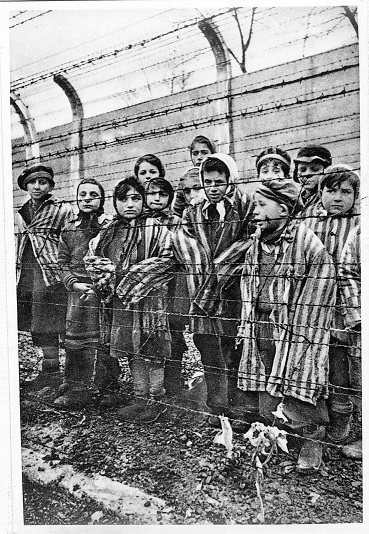
At that time, more and more transports of Jews were arriving from Theresienstadt.3 After selection on the ramp, approximately 350 pairs of twins, between one and sixteen, of the same or different sexes, were brought to this block. Their parents had, of course, been sent to the gas chambers. These Jewish children were from various countries: France, the Netherlands, Belgium, Hungary, and Germany. They still looked healthy and pretty, but were frightened and tearful. They slept two or four to a bunk, depending on age, on straw mattresses with no sheets or pillows. Each bunk had two blankets.
Their food consisted of black camp bread, margarine (jam and white bread on Sundays), black coffee, milk soup, noodles, groats, sausage once a week, potatoes with cooked rutabaga, and cheese. Regardless of age, all the children received the same portions, which were very low in calories and nutritional value with no vitamins (fruit, etc.) or fat.
The block staff consisted of the block senior and two women who were assigned to help me (I do not remember their names, as we were together only for two months).
July and August of that year were extremely hot, with practically no rain. The three of us had to wash the children every day (the older ones helped us) using small basins and very limited amounts of water. Maintaining the children’s personal hygiene was the only preventive measure available to us to avoid infections or epidemics. However, it soon proved to be a far more difficult task than we had expected. Water had to be “organized”4 in the same way as every other necessary. As a result, despite our efforts, sanitary conditions left much to be desired and had a disastrous effect on the health of our children.
Within the next few weeks, the children began to show the first symptoms of vitamin deficiency (scurvy), inflammation of the throat and eyes, swelling of the limbs, and pneumonia. The greatest danger came from the rats, which were as large as big cats. They scurried about day and night. There were cases of rats throttling children in their sleep at night. Lights were not allowed on after dark. Our night shifts could do little to help, because the block was very long, and by the time we heard a child’s whimper or scream and managed to reach the spot, the child was already lying dead with its throat gnawed through. Just imagine how terrible it must have been.
The situation was made even worse by the complete lack of underwear and spare clothing for the children, as well as the shortage of medicines. In every respect we were dependent on our own ability to “organize” whatever was needed. No one in the camp offered us even the slightest assistance. Nevertheless, I managed to establish contact with two doctors from the men’s camp, Dr. Zygmunt Herman, a surgeon, and Dr. Fastman, an ear, nose, and throat specialist. These two physicians sent small amounts of medications over the barbed-wire fence – antiseptics, aspirin, ointments, drops, and dressings.
In serious cases of illness, when a child had to be sent to the Revier (infirmary), it never returned to us.
We often asked ourselves what the block was for. The answer soon came. After three weeks, we were informed that a commission would be coming to our block. Indeed, at noon one day in mid-August, Dr. Mengele5 arrived accompanied by two German non-commissioned officers and Stenia, the Lagerälteste (senior camp prisoner). After inspecting the block, he ordered me to bring the children in groups, arranged by age and according to a list of registration numbers (all the children had numbers tattooed on their arms) to the dispensary located in the men’s camp. They were to be “examined.” Later it turned out that these examinations were to be anthropometric, radiological, and hematological tests. They were intended as a preliminary for later experimental operations; that was what I was told by one of the Polish women doctors.
The anthropometric examinations were conducted by keeping the children stripped completely naked for two to five hours at a time, and taking measurements with precision instruments such as protractors, calipers, and sliding gauges. Pairs of twins were examined and their measurements compared to determine whether they were identical. Extensive records were made. These examinations were a severe ordeal for the children. Frightened, exhausted, hungry, and cold, they had to get up at six in the morning and walk the one-and-a-half-kilometer distance from the block to the dispensary.
The next examinations were the X-rays, carried out in the same conditions. By then it had become quite cold, as it was late September and early October, and the examination room was not heated. The children stood naked in front of the X-ray screen for five to fifteen minutes because the image was discussed and analyzed during a fluoroscopic examination. The consequences of these “examinations” did not take long to appear. The children developed fevers, sore throats, severe coughs, sinus infections, and often pneumonia. Medical experts can judge for themselves to what extent these conditions were caused by the children’s prolonged exposure to X-rays, as well as by the nervous strain and conditions in which they were kept.
Particularly dramatic were the last examinations, the hematological tests. Blood was first taken from the children’s fingers and then from a vein, sometimes two or three times from the same victim. The children screamed, struggled, and would not let themselves be touched. They were terrified of needles. The personnel resorted to force. I cried together with the children. Eventually I was ordered to leave, as I was no longer able to calm them down. Afterwards, when they came out of the examination room, sobbing uncontrollably, they would throw themselves into my arms. I hugged and kissed them warmly and gradually calmed them down.
Meanwhile, new groups of children were brought in for examination, and now blood was being drawn (20 cubic centimeters at a time) from the veins of those who had already been “examined.” It was preserved in separate bottles for each child. Supposedly it was intended for soldiers on the front. Each of these selected children gave an average of 20 to 50 grams of blood over a period of six weeks.
By October, there were only about three hundred children left alive.
Another part of the experiments involved the administration of eye drops. I did not see the procedure itself because the children were taken into an adjoining room. One pair of children would have both eyes treated, while another would receive the drops in only one eye. I was instructed merely to observe their reactions but not to intervene in any way, regardless of any changes, redness, or swelling that might occur. The consequences of these procedures were painful for victims. Severe swelling of the eyelids developed, accompanied by burning sensations and excessive tearing. Such reactions appeared about six to eight hours after treatment. I was required to bring the children back after two days. They were suffering a lot, but I did not know what substance had been used, so I acted instinctively and obtained milk or whey, which I applied in compresses to their sore eyes. The swelling did not subside, but the children said the burning sensation diminished. That was all I cared about – to stop the suffering. At the next visit, when I was asked about the children’s reactions to the treatment, I did not admit that I had used these compresses. The children were kept behind and did not return to the block with me.
At the end of October, our block was moved to the Roma camp. The non-Jewish personnel remained in Birkenau, while I went with the children. Conditions there were even worse because we were sent to a block intended for adults, equipped with tiered bunks and without a stove. The examinations of the children continued. Disease attacked their exhausted bodies ever more severely. Their mouths went swollen, and they developed scurvy, severe eye infections, and diarrhea. More started to die. Once again, some of the victims were kept behind after a test, and I never learned what became of them.
The block grew colder and colder. The first snow fell, and there was little hope that the children still alive would survive the coming winter. This situation lasted until January 17, 1945, the day when the camp was evacuated. All the healthy adults were ordered to leave, and I was among them. I left about 150 children in the block and did not even have time to say goodbye to them.
Soon afterwards the camp was liberated, and those who were still in it were cared for by the Red Cross.
This dry account cannot fully convey the cruel reality and atmosphere of terror and intimidation; it is only a sketch of what I experienced and witnessed. I came to understand how important kindness and compassion were in conditions in which the possibilities for prevention and genuine nursing care were so severely limited. Thanks to these children, I recovered my emotional balance and will to live, yet I could only do so little for them.
I should perhaps add that some of the children survived. In August 1944, a small transport of Jews arrived from Płaszów.6 One of them was a boy of six, Henryk (“Henryś”) Sytner,7 together with his mother. He was separated from her. Henryś hid with me in the block. He survived the camp, became a journalist, and is working for Polish Radio. After the war, by a miracle he managed to be reunited with his mother.
- The original Polish version of this article was published in the 1967 edition of Przegląd Lekarski – Oświęcim. ↩︎
- Auschwitz-Birkenau survivor No. 46506. ↩︎
- Theresienstadt was a temporary ghetto Nazi Germany established in occupied Czechia as a staging post on the way to an extermination camp. ↩︎
- In the concentration camp jargon, “to organize” something meant to procure it by illicit means. ↩︎
- For more on Mengele on this website, see Helena Kubica’s article, “Doctor Mephisto of Auschwitz” in the 2019 volume of Medicine Behind the Barbed Wire Conference Proceedings, at Medical-Review-Auschwitz-Medicine-Behind-the-Barbed-Wire.-Conference-Proceedings-2019.pdf ↩︎
- Płaszów was a staging point on the outskirts of Kraków where Jews destined for Auschwitz were collected. ↩︎
- Henryk Sytner, b. 1937, survived Auschwitz and made a career as a sports commentator for Polish Radio. ↩︎
How to cite
Piekut-Warszawska E., "The Auschwitz Children. A Nurse’s Memoirs", Kurtyka A., trans. Originally published as "Dzieci w obozie oświęcimskim (Wspomnienia pielęgniarki)", Przegląd Lekarski – Oświęcim, 1967: 204-205.
The Medical Review Auschwitz Project is an international academic forum whose purpose is to share information, scholarship and views on matters related to learning about and from the history of medical involvement in Nazism and the Holocaust. All opinions expressed by any author, speaker or participant are solely his or her opinion and not the opinion of the Project, its organizers or any other participants in the Project.