(Lung Clinic of the Kraków Medical Academy, Head: Prof. Dr. Stanisław Hornung)
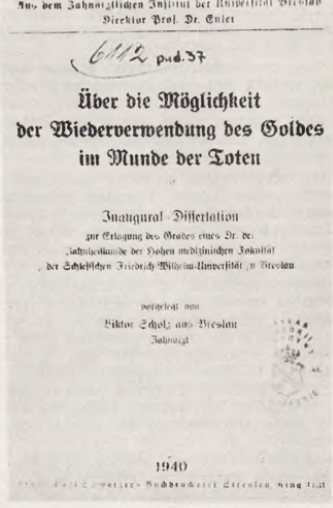
In this paper I1 present two documents that are, in some measure, representative of the plans of Nazi Germany to obtain the gold from dental restorations in the mouths of the deceased and recycle it for the economic benefit of the Third Reich. The first document, part of which I have translated into Polish, is the abstract of the doctoral dissertation of the dentist Viktor Scholz, which was presented at the Medical Faculty of the University of Breslau in 1940 and later published, by authority of Prof. Dr. [Hermann] Euler, Head of the Institute of Dentistry, who had supervised Scholz’s work, and Prof. Dr. [Heinrich] Gottron, Dean of the Faculty.
The principles on which this dissertation was based as well as its pseudoscientific style require no comments.
Viktor Scholz concludes his research by saying that the recycling of the gold extracted from the mouths of the deceased in the economy of the Third Reich is still an open question, since his work “is not a closure to the problem, it’s only the beginning.” Indeed, a few years later the issue received a practical solution, and how it was resolved is described by the second document, a brochure which was written in German and put into circulation in 1944 by the Polish resistance movement.
***
VIKTOR SCHOLZ, “On the opportunities to recycle gold from the mouths of the deceased”2
I. The Four–Year Plan3 and the use of gold in dentistry
The titanic struggle that the German people are making now to revive and stabilise their economy is the reason behind the implementation of many regulations which have brought about various changes, also in dentistry. The allowance of gold from the Devisenstelle [Foreign Exchange Office] is getting smaller and smaller, and therefore it is becoming ever more difficult to acquire gold for dental restorations. Efforts to support the national economy by recycling the gold used by a former patient, that is utilising gold extractable from the mouths of the deceased, have come up against objections. Already in 1925, Zahnärztliche Rundschau4 published an article by [Dr. Albert] Werkenthin on the problem,5 writing that the German economy was losing about four million marks’ worth of gold annually, that this estimate was much too conservative and the recycling of the precious metal from the dentures of the deceased was impracticable and unethical.
Yet it seems that in connection with the Four–Year Plan, the question of extracting gold from corpses should be reconsidered and suggestions offered to resolve it. To that end, first the findings of Prof. [Christian] Greve of Erlangen on the estimated amount of gold used in dentistry, published in Zahnärztliche Mitteilungen (Vol. IV, 1937) should be considered. [Given the average amount of gold that a German dentist uses monthly, which is about 15 grams, the savings could reach] 16 million [reichs]marks: this is the value of the gold used per annum for dentures.
What happens to the gold reprocessed by dentists and dental technicians for dental prosthetics? Some of it is recovered still during the denture wearer’s lifetime, so it can be recycled. This amount can be estimated at about one-third of all the gold used to produce dentures, and that is not too high an estimate. That one-third is returned to the national resources as a consequence of periodontosis, periapical abscesses, poorly fitted dentures, and finally due to the focal infection theory, which for some time induced American dentists to remove their patients’ crowns and bridges. The rest of the gold is thoughtlessly buried with the denture wearers and remains interred for thirty, sixty or more years, to be retrieved only during exhumation or reinterment, or it may stay under the ground forever, at a loss to the national economy.
Therefore the aim of this study is to find if it is possible to reuse the gold from the dentures of the deceased.
II. Legal aspects.
A. Does a denture wearer have the right to decide that the gold be taken out of his or her mouth after his or her death?
B. Do the heirs of a denture wearer have the right to request the removal of the gold from the mouth of their deceased relative?
C. Can the national authorities institute legislation for the extraction of gold from cadavers?
To answer those questions, it is necessary, first of all, to provide a brief overview of the legal issues pertaining to dentures, belonging either to living or deceased wearers, with an important distinction between removable or fixed dentures.
Removable dentures, such as false teeth, are not permanently incorporated into a person’s body. They are worn in the oral cavity, but are not treated as a part of the wearer’s body. Such an item is always a thing (Sache), as defined in §90 of the German Civil Code (Das Bürgerliche Gesetzbuch, BGB)6 and implied by §811, Point No. 12 of the Civil Procedure Regulations (Zivilprocessordnung, ZPO), which prohibits the post mortem expropriation of prostheses as collaterals in lieu of a deceased’s debts. This provision would cease to hold if the legislator did not treat dental prostheses as things.
Fixed dentures, such as a cap or bridge, which are permanently incorporated into the human body, become its components. In fact, the BGB defines a “component” only in reference to things, while a living body, in the light of [German] law, is not a thing: the law does not regulate legal relations with respect to a human body. On the other hand, one could argue using the following analogy: if something becomes a component of a thing when it is affixed to that thing, it becomes a component of a live human body when it is affixed thereto, and as such a component, it shares the legal status of a live human body. Therefore, since the law does not treat a live human body as a thing, the same must hold for fixed dentures. This is the prevalent understanding of the issue.
If a removable denture is taken out of the mouth of its wearer, it becomes a separate thing, as defined under §90 of the BGB, which in one interpretation of the legislation continues to be the wearer’s property even though no further formalities need to be completed. In a different interpretation, it becomes ownerless, but the wearer has the right to be the first to claim ownership; his or her ownership rights may also be accepted by tacit agreement.
For deceased wearers, removable dentures that used to be their property in their lifetime, after their decease continue to be things and may be inherited and owned by their heirs. A fixed denture which used to be a component of the wearer’s body, post mortem becomes part of the cadaver.
The legal aspects of the use of dentures can be summed up as follows:
- A removable denture:
a. is the property of the wearer while alive;
b. after the wearer’s death it becomes the property of the heirs.
- A fixed denture
a. is a component of the wearer’s body during his or her life;
b. is a component of the wearer’s dead body.
A. Does a gold denture wearer have the right to decide that it is to be taken out of his or her mouth after his or her death?
This question does not apply to removable dentures, because there are no legal or practical impediments to the removal of a removable denture from a dead body. In everyday-life situations, such a denture is usually removed when the dead body is washed and sometimes it is taken out by the person while still alive or by the next-of-kin and put away when it is of no use any more.
The situation with a fixed denture is entirely different. Since legally it is part of the body, any decision to have it removed after death would be subject to the same legislation as a decision to perform a post-mortem / an autopsy.
The majority of legal experts recognise that dispositions relating to one’s own corpse can be made on condition that such dispositions do not stand contra bonos mores. Some experts, however, are of the opposite opinion and say that a dead body is no longer private property and as such is not subject to commercial exchange. They postulate that it is pointless to ask how it is possible for a person to acquire a right only after his or her death. They also claim it is pointless to talk about common decency, because the regulations that govern the handling of a dead body are unique and preclude any dispositions relating to it by a person who is still alive.
The position of the Reichsgericht (German Supreme Court) in that matter is different. Its verdict of 7 March 1912 (Juristische Wochenschrift 1912, p. 590)7 is based on the grounds that every human being has the right to make dispositions concerning his or her dead body. Thus, a disposition made by the wearer of a gold denture relating to its removal after his or her death is lawful.
B. Do the heirs of a denture wearer have the right to request its removal from the mouth of their deceased next-of-kin?
They could make such a request if they had the right to do so, which would happen in the following cases:
1) if, following the wearer’s death, the denture became the property of the heirs;
2) if the corpse were a thing and part of the heritable estate; as part of that body, the denture would be treated accordingly;
3) if the heirs were given this right on the grounds of special legislation.
Ad Item 1): A removable denture, which under §90 of the BGB is a thing, becomes the property of the wearer’s heirs after his or her death and therefore may be extracted from the wearer’s mouth. On the contrary, a fixed denture does not become a thing under §90 of the BGB and thus cannot be inherited, because it is part of the corpse. There is no provision on the grounds of which the heirs may have a fixed denture removed from the oral cavity of their deceased relative’s body.
Ad Item 2): There is still a possibility that a corpse might be considered a thing as defined under §90 of the BGB, a thing that can be inherited by the heirs of a denture wearer, and thus a denture as its part would be part of the deceased’s estate.
The question whether a human corpse is a material thing in the understanding of §90 of the BGB has long been debated in the legal sciences. Some lawyers affirm this claim, but others reject it, saying that a corpse continues to be subject to personal law, which in this event would seem to operate retroactively.
Doubts may arise as to whether a human corpse should be denied the status of a thing – also due to the fact that §168 of the Penal Code includes an option to grant legal protection to a human body in the care [of an authorised person]. Admittedly, the Reichsgericht has not taken a clear stand on the status of dead bodies as things, yet it has rejected the claim that following a person’s death, his or her next-of-kin, or any other person may acquire the right to own the dead body. Another absolutely erroneous claim is the sporadically voiced opinion that the dead body is part of the estate of the deceased and as such, pursuant to §1922 of the BGB, it becomes the property of the heirs. As the heirs hold no property rights to claim the dead body, there are no legal grounds on which they could have a denture removed from it.
Ad Item 3): There are no legal grounds permitting the heirs to extract gold from the mouth of a deceased person.
Accordingly, the question whether the heirs have the right to have a gold denture removed from the oral cavity of their deceased next-of-kin has to be answered in the negative.
C. Can the State institute legislation mandating the extraction of gold from corpses?
As a matter of fact, this question should be answered in the affirmative, because the State, which is the supreme legislator [in Germany], definitely has the powers to institute such a legislative act. Yet, how would such legislation be viewed by the vast majority of the general public? How could it be implemented?
a) The problem of pious duty to a person’s dead body
History shows that from the earliest times man has shunned the abuse or irreverent handling of corpses. This anxiety stemmed not only from respect for the dead, but above all from the belief that after death the body continued to have some connection with the soul, which, as it was believed, required the living to bury their dead so as to let their souls rest in peace. Importantly, people thought that a soul that knew no peace could do harm to the living. Such beliefs had an impact on how dead bodies were treated; mishandling was considered a disturbance of their peace.
In the interests of science, these scruples were first overcome in Italy. We have a report that the first autopsies were carried out on the initiative of Martianus, chief physician of Sicily in Salerno in 1238, during the reign of the farsighted [Holy Roman] Emperor Frederick II [Hohenstauf]. More and more of these procedures were conducted from the fourteenth century onwards and the pope ultimately lifted the ban on them, but it was not until the seventeenth century that the fear associated with the dissection of a human corpse gradually disappeared.
Even this concise overview of the historical developments shows the considerable difficulties that had to be overcome, which sometimes resulted from respect for the dead, but usually from irrational fear and superstition. Nowadays no one has any doubts that dissection is necessary for scientific purposes. The primary purpose is to obtain knowledge about the human anatomy. Another purpose is to perform an autopsy for clinical reasons; such autopsies, if carried out on a more routine basis, would meet with strong resistance from the general public. The same response could be expected if legislation for the mandatory extraction of gold from the mouths of the deceased came into force, because the procedure would be performed on the corpse of anyone who had a gold denture, and the scientific purpose would be superseded by a purely materialistic incentive. Such an approach runs counter to the respect most people have for the dead. So, provisions like the ones I have described above would have to be introduced for the sake of a higher good, more important than the delicate sensibilities of the citizens.
To avoid hurting the feelings of the public – since respect for the dead is praiseworthy as such – it could be done only if an immense, overriding common good prevailed. Nevertheless, it is clear that legislation making the extraction of gold from the mouths of the deceased legal could cause the State more harm than the abandonment of such an idea. It is true that millions are at stake, which are being interred with the deceased and lost for the national economy; such a forfeiture comes at an especially high cost during the current economic crisis. So, now it is even more important to ask whether the material gain can recompense the cultural damage. The answer must be “No,” because any material gain the State could expect and the advantages it could bring for particular persons are of lesser importance than the severe emotional damage they could bring. Even so, respect for a dead body is not a permanently established custom, but has evolved through time, and its general acceptance cannot be based on the views of a single individual, but on the opinion of the majority. Most communities recognise the prohibition Noli me tangere8 and handle dead bodies with respect, which has to be taken into consideration when we deal with fundamental religious beliefs and customs.
b) Practical aspects
If we had legislation prescribing the extraction of gold from the mouths of the deceased, the physician certifying a death would have to indicate in the medical death certificate that the deceased wore a gold denture. In that event, the gold would have to be extracted. However, what could be the position a dentist might take? Here are some examples of arguments [from dentists] for and against the removal gold dentures.
“The extraction of gold would leave the family resentful and agitated out of proportion to the material gain obtained and the costs, because I don’t suppose that even the keenest supporters of the idea would volunteer to perform the procedure as a regular duty and free of charge” (Könnecke, Zahnärztliche Rundschau, 1925, No. 43).
“A person who died after a long period of suffering should be protected against any procedures performed just for the sake of a few grams of gold, even though a dead body is an inanimate thing. We can imagine how ‘delicate’ such procedures could be, and there is no point in discussing that further. Presumably, not many of my colleagues would be ready to take up such ‘pleasant’ activities. As for myself, I have always considered a dentist’s work to be the work of a doctor, and a doctor’s vocation is to help patients, not to prospect for gold in the mouths of the deceased” (Buff, Zahnärztliche Rundschau, 1925, No. 43).
“The essence of this unpleasant matter is neither this nor that. No one would object to extracting gold from dead people’s mouths if it were as easy as taking out a removable denture. This is the crucial point: the ostensible brutality of the extraction, which looks like failure to respect the body of the deceased, because the procedure is performed for material gain” (Werkenthin, Zahnärztliche Rundschau, 1925, No. 43).
In all likelihood, such critical attitudes will never be reconciled [with the views of those in favour of post-mortem extraction] as they are based on a different worldview.
III. Potential solutions
1. Removal immediately after death
This solution is feasible if the denture wearer made an appropriate disposition on the grounds of which the heirs can have the gold removed from his or her mouth. As I have said in the foregoing, this solution is viable, but of little value in practice. Who will execute such a disposition? For the State, individual instances are of negligible value, while most heirs will abandon fulfilling such a disposition, because they want to treat the corpse with respect and reverence. There is no legislation to bind the heirs to perform such a disposition made by the deceased person and we can hardly expect the next-of-kin to obey provisions that are deeply hurtful to their feelings.
2. Removal from the ashes
The simplest method of recovering gold from the mouths of the deceased could be applied if all corpses were cremated. Then the gold would be removed from the ashes and nobody’s feelings of respect for the deceased would be injured. The ashes are completely depersonalised remains. Referring to his interviews with managers of crematoria, Werkenthin writes that during cremation a corpse, along with the gold dentures it may contain, is exposed to a temperature of 1,000 degrees Celsius for an hour, and that to date, no traces of gold have ever been found in the ashes. Pfaff reports that at his request, three hours after his relative had been cremated, the operatives delivered three well-preserved gold inlays to him (Zahnärztliche Rundschau, 1925, No. 43). In my enquiries with the managers of various crematoria, I obtained the following information: no gold has ever been found in the ashes after a cremation; gold melts at 1,063 degrees Celsius, while bodies are cremated at 800–1,200 degrees, so the gold is either absorbed by the ashes or is so thickly covered in them that in practice it is never retrieved.
It is hard to say whether these negative outcomes stem from the fact that the managers of crematoria have had little or no interest in the problem so far, but surely one could find a method to recover the gold from the ashes without offending anyone’s feelings. Nonetheless, the economic profit derived from such a procedure would still be limited, because not all corpses are cremated and it would be impossible to introduce legislation for mandatory cremation due to religious prohibitions.
3. Removal during re-interment
Removing the gold from the remains of a corpse following burial on exhumation and re-interment would present even greater difficulties. First of all, the administrator of the cemetery would have to register all the deceased buried with gold dentures for the gold to be retrieved on re-interment. It is obvious that such a procedure would involve many problems. Furthermore, the exclusive right of burial period [for which the grave must not be disturbed following interment] would have to be observed; in the district of Breslau, for instance, it is twenty-five years.
4. A ban on gold for restorations in anterior teeth
It would be fairly easy to pass a draft bill of this sort, though its value would be preventive. Nowadays dentists can be practically as successful when using white composites instead of gold inlays in posterior teeth.
Even though the findings of this review show a bias towards the negative, that is not a closure to the problem, it’s only the beginning. (Printed by Paul Schwarzer’s Buchdruckerei, Strehlen, Ring 30–31.)
***
In 1944 the Polish resistance movement used information from Auschwitz prisoners to issue the following brochure in German entitled Die Zähne von Auschwitz (“Teeth from Auschwitz”) which was circulated among German inhabitants:9
Near Auschwitz station you can see a sideline for Birkenau. Trains pass along it for 1 km, and then go through a gate tower; further on, you can see barbed wire and watch towers. The passengers, curious and a little apprehensive, look through the windows. This is going to be their new place. What kind of life can they expect for themselves, their wives and children? Where are they going to work? On either side they see a city of barracks. You can see prisoners everywhere, building roads, clearing ditches, unloading building materials from train cars. The train stops and you have to get off. Finally, you have reached your destination, and the journey may have taken several days. The train is surrounded by soldiers armed with weapons ready to fire, and with machine guns. The transport is received by about ten officers. The children are brought out into the fresh air, then coffers, baskets, and other bundles are unloaded. The officers seem almost friendly. They even explain where the luggage should be piled up (as it will be delivered to you on a truck)10.
“The new arrivals are divided into groups: the women, the children, and the sickly are separated from the strong men and some of the young women. ‘No need to say goodbye, really,’ a kind elderly man reassures you. ‘Now you’ll be taking a bath, and in a half hour you’ll see each other again.’ The men and young women walk away. They are escorted by SS men. They can see that the other women and children are getting into trucks; it is the last sight of them.
“After a two-minute march you see sturdy buildings with graceless chimneys, scattered over a flat terrain. These are the Auschwitz crematoria. This is where the women, the children, and the elderly have to undress. As they are going to ‘have a bath,’ they need to put away their jewellery and their money. Then, in groups of a few hundred, they are herded into low-ceilinged, cold, windowless premises. A man in a gas mask empties two or three boxes of coarse granulated stuff onto the floor and before anyone can say a word, he leaves the room, and the heavy door closes behind him.
“The people feel an awful metallic taste on their tongues. The bitterness invades the throat and scratches it, you start panting, and then there is only the screaming, the screaming of hundreds in their purposeless, hopeless panic. Children get convulsions, seek refuge in the arms of their mothers and die. Adults drop to their knees, their mouths and noses running with mucus, they gasp for air, and collapse onto the floor in a tremor. Finally, overcome with pain, they all lose consciousness.
“After a few minutes the ventilation hatches open up. The door is unlocked too. Prisoners and SS men walk in. They inspect the dead bodies, still warm, and extract the gold teeth, all the false teeth.11 They must hurry up, so it is all right to damage the periosteum, because the next seven hundred are waiting their turn.
“In this way, every week in Auschwitz, fifty or sixty thousand people are killed with Prussic acid. Victims include Warsaw insurgents, Jews from Theresienstadt, Budapest, Žilina [Slovakia], and Łódź, innocent people, vulnerable and trustful. The crematoria work at their maximum capacity and can’t cater for all the needs. So, a few hundred metres away there are open-air bonfires sending the hiss and stench of burning bodies far up over the fields.
“Can the gold pilfered from gassed victims help the Third Reich fight its ‘holy war of the German nation’? Can the false teeth of the suffocated do that? No, mein deutscher Kamerad. Have you had a new denture since 1941? You’re not to be envied. The false tooth in your mouth is part of Hitler’s loot, given to you as a gift. With this tooth, you’re being bitten by a Jew from Antwerp or Thessaloniki. Every brave German can have false teeth pulled out of a froth-filled mouth killed in Auschwitz. That is the gift you get from National Socialism.”
***
The documents which I have quoted have not been published yet, as far as I know. During the Nuremberg trials the economic exploitation of human cadavers was quite thoroughly investigated in various aspects, such as the extraction of gold teeth from bodies,12 the commercial processing of women’s hair, the production of human bone meal and of soap from human fat, and the crafting of decorative objects such as lamp shades or book covers from human skin.
- Auschwitz survivor, prisoner No. 20019. ↩︎
- The title page of Scholz’s dissertation reads “Aus dem zahnärztlichen Institut der Universität Breslau. Direktor: Prof. Dr Euler. Über die Möglichkeit der Wiederverwendung des Goldes im Munde der Toten. Inaugural-Dissertation zur Erlagung des Grades eines Dr. der Zahnheilkunde der Hohen medizinischen Fakultät der Schlesischen Friedrich-Wilhelm Universität zu Breslau, vorgelegt von Viktor Scholz aus Breslau, Zahnarzt, 1940. Druck: Paul Schwarzer’s Buchdruckerei, Strehlen [now Strzelin, Poland], Ring 30—31.” (See the illustration, showing a reproduction of the original document, which is preserved in the Jagiellonian Library, Kraków. https://mra.piebm.org/wp-content/uploads/2025/06/Przeglad-Lekarski-%E2%80%93-Oswiecim-1964-volume.pdf). A photo of Scholz, his title page and potted biography also appears in Advances in Clinical and Experimental Medicine, 2006, 15, 3, pp. 557–561. We have produced an English translation of Stanisław Kłodziński’s Polish translation of the document and cross-checked our rendering for accuracy with the original publication. Viktor Scholz’s potted biography is appended at the end of the dissertation, and gives the following information: “I, Viktor Scholz, was born in Lodz [Łódź] on 13 July 1904. My father, Wilhelm Scholz, was a foreman and my mother was Luise née Michel. I attended primary and secondary school in Leobschütz in Upper Silesia [now Głubczyce, Poland] and I finished grammar school and obtained the school leaving [Abitur] certificate in the Easter term of 1924. On 1 May 1933 I went up for Dentistry at the University of Breslau [now Wrocław, Poland]. I sat the initial examination for the speciality in 1936 and graduated in 1938, passing the final state examination.” ↩︎
- Hitler’s Four-Year Plan (1936–1940) was an economic programme designed to rearm Germany and prepare it for a wartime economy. ↩︎
- Zahnärztliche Rundschau, German professional journal for dentistry, published 1891–2021. ↩︎
- Kłodziński is referring to an article entitled “Das Gold der Toten” [The gold of the deceased], which appeared in issue No. 39. ↩︎
- The BGB came into effect throughout Germany in 1900, and was looked up to in many parts of the world and emulated as an admirable legal standard. In Nazi Germany attempts were made to modify the BGB in line with Nazi ideology, but eventually no major amendments were made, only certain interpretations were preferred. ↩︎
- See https://archive.org/details/juristische-wochenschrift-41.1912/page/595/mode/2up ↩︎
- “Do not touch me,” the words of Jesus Christ when he appeared to Mary Magdalene after his resurrection (St. John’s Gospel 20: 17). ↩︎
- Local units of the Polish resistance movement, the largest underground organisation in occupied Europe, established secret contacts with individual inmates held in concentration camps and obtained information from them on what went on in the camps. For more on this point, see other articles on this website, e.g. Teresa Lasocka-Estreicher – Medical Review Auschwitz [E-library]; Biographical notes on some of the deceased Polish doctors and medical staff who rendered distinguished service in the care of Auschwitz prisoners – Medical Review Auschwitz [E-library]; Dr Helena Szlapak – Medical Review Auschwitz [E-library] etc. The Polish resistance had a special unit that produced flyers informing German troops that Germany would lose the war. ↩︎
- On arrival in Auschwitz, new prisoners had to fill in a registration form on which one of the questions asked if they had gold teeth. ↩︎
- In this footnote Kłodziński quotes the Polish version of the book Obóz koncentracyjny Oświęcim-Brzezinka by Jan Sehn; in this translation we use its English version, Oświęcim–Brzezinka Auschwitz–Birkenau Concentration Camp, Warszawa: Wydawnictwo Prawnicze. pp. 144–145. Translated by Klemens Kęplicz, 1961.
“Even during the period of the first mass Jewish drafts, Adolf Eichmann arrived in [Auschwitz], with an order from Himmler to extract gold teeth from the bodies and to cut off the hair of gassed women. This was done immediately before the loading of bodies into the ovens. Gold teeth were at first melted down by SS dentists in an SS surgery. Later, a gold smelting laboratory (Goldgiesserei) was built in Crematorium III. Forty inmates were employed on ‘dental’ work in the crematorium; up to twelve kilograms of gold a day were melted down at various periods. Gold teeth were also extracted from the bodies of numbered inmates. Extant reports by the manager of the camp dental centre disclose that, in 1942, altogether 16,325 gold and platinum teeth were extracted from 2,904 numbered inmates. Gold thus obtained was sent in ingots to the Sanitary Office (Sanitätsamt) which distributed it for the use of the SS dental service. But even by 1942 the available gold far exceeded the demand, with a surplus of more than fifty kilograms, so that the Sanitary Office declined further supplies and asked Himmler [in a letter dated 8 October 1942, as added by Sehn in a footnote – MK] for authority to consign gold to the Reichsbank.” ↩︎ - Dr. Miklos Nyiszli, Auschwitz survivor, prisoner No. A-8450, had to join the Sonderkommando by order of SS physician Josef Mengele. In 1951 Nyiszli made a written record of his experiences in the camp. He used to work in the crematorium as a pathologist and witnessed the procedure for the removal of gold teeth. “A Kommando consisting of eight men, the tooth-pullers, is waiting in front of the ovens. Each of them is holding a crowbar in one hand and a pair of pliers to extract teeth in the other. The dead are turned onto their backs, their mouths are opened, and their gold teeth and bridges are removed. The work is quick and ruthless. The teeth are knocked out rather than pulled out. Yet the men in this Kommando are without exception excellent dentists and oral surgeons. Dr. Mengele insisted, and he was very clear on that point, that only first-rate specialists should volunteer for this work. And they did, because they expected to get work in their profession, just as I did, too. The gold teeth are placed in a bath of hydrochloric acid to dissolve the bits of flesh and bone still on them … Gold is heavy — I estimate that in the crematoria, eight to ten kg could have been collected per day.” [Kłodziński translates from p. 89 of a book that was published in German and includes Nyiszli’s text: Nyiszli, Miklos, “Sonderkommando”, pp. 84–93 in Adler, H.G., Hermann Langbein, and Ella Lingens-Reiner, eds., 1962, Auschwitz: Zeugnisse und Berichte, Frankfurt am Mein: Europäische Verlagsanstalt. We have cross-checked our English translation with the original German.] ↩︎