
Explore the latest conference recordings
We invite you to watch new video materials from the Medical Review Auschwitz Conference: Medicine Behind the Barbed Wire 2026 and revisit its insightful lectures and discussions.
Episodes from My Time in the Prisoners’ Hospital of Auschwitz
Katowice1
I2 was one of the prisoners of Auschwitz who contracted epidemic typhus there and survived thanks to the medical care they received in the rewir (prisoners’ hospital). Later I worked there as a hilfspfleger (auxiliary nurse). I think it might be worthwhile to add a short account to what has already been published on life in the prisoners’ hospitals of Auschwitz.
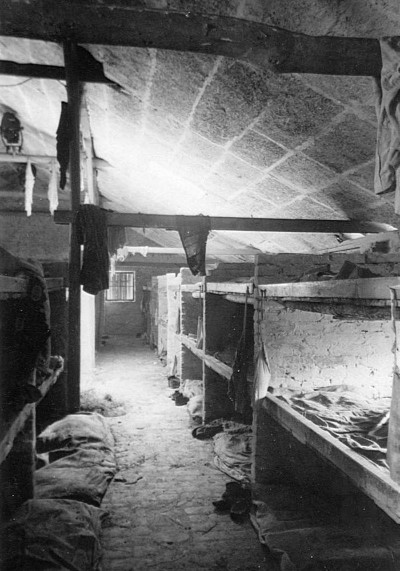
When the fever stopped and my temperature went down, that didn’t mean I had fully recovered. It only meant that I had regained consciousness. The doctors and nurses stopped at my bunk to check my temperature and gradually restore and help my debilitated body recover. I was so weak that I could not make it on my own to the toilet in the corner of the room. A nurse or a convalescent inmate always had to help me. I weighed 34 kg (74 lbs.). Three other sick prisoners must have died on the bunk next to mine, I think, before I was strong enough to walk and do all the necessary things on my own.
The doctors noticed that I was young (born in 1923) and did not let me eat a lot, so as not to bring on diarrhoea. I couldn’t eat normally until after about a fortnight. I was given a double helping of soup and an extra portion of bread. The senior orderly saw that I was quickly recuperating and told me to help other convalescents with their first steps after typhus. So I helped other patients taking them to the toilet, tidying up their bunks, and distributing tea and soup.
Later on, I was put on nachtwache (night watch) for two or three hours. It was a job on the typhus ward. Sometimes a patient would suddenly wake up, start yelling and running around between the bunks, banging and injuring his head. Another would try to get out through the window and throw himself on the electric fence. You had to run after him, catch him and bring him back to his bunk. Night duty was exhausting and ghastly. Sometimes a patient running a fever would blab his nom-de-guerre or code name in the resistance force3, or report to his superiors in the army. Another would say out loud how much he loved his wife, while yet another would burst out weeping because he had been unfaithful and now in his fever made a public confession of his sin. Others would pray out loud. Sometimes a patient would give a terrible yell, sit up on his bunk and die.
Typhus patients running a fever were dreadfully thirsty. You had to keep bringing them a drink of water or the ersatz tea brewed in Auschwitz, and carry out the full bedpans of bedridden patients. Sometimes you had to hold the hand of a dying patient, because that’s what he wanted from you. In the dead of night, in a room with dimmed lights and 30 patients all breathing, the air was close and there was an awful atmosphere of suffering and horror. I felt relief when I passed nachtwache on to the convalescent who came on duty after me.
After three weeks I was transferred to the schonung (convalescents’) room on the first floor of Block 20. It was a large hall with bunks for about a hundred prisoners. Stanisław Głowa4 was room senior, and Stanisław Rospenk5 was his right-hand man. They knew me from the typhus rooms looked after by Józek Hordyński6, Bohdan Lewandowski7, and Czesław Ostańkowicz8, where I had occasionally done night watch. Głowa decided to give me a job, with the consent of the block senior, to help out as an auxiliary nurse, though I was still registered as a patient. I now got additional duties on top of those I was already doing. I was responsible for keeping the place clean and tidy, and seeing that the beds were properly made for patients in several rows of bunks. In addition, I had to join other nurses to carry the barrels or pots of concentration camp soup upstairs and distribute bowls of soup to bedridden patients.
A new job I was given was disposing of the bodies of fellow inmates who died. This was usually done by the nurses, but the corpses had to be taken down from the bunks. Usually I did this with Rospenk. The two of us would drag the corpse out of the bunk and lay it out on a blanket spread out on the floor. Next we had to write the dead man’s prison number using an indelible pencil on his chest and forearm. Then we rolled up the blanket and took it downstairs and out into the corridor, from where the leichenträger (corpse disposal) commando carried it out. They put the bodies on a special cart, two or three at a time depending on their weight. They had straps tied to the sides of the cart and put the middle part of the straps round their neck like a yoke, so they could pull the load up to a hay wagon that stood waiting in the yard, or straight up to the crematorium. About five to ten prisoners died every twenty-four hours in the room where I was on duty. Carrying out the bodies was a sad and unpleasant duty, for all intents and purposes a funeral conducted in the conditions of a concentration camp.
But one of the nastiest jobs was cleaning the bunk on which a prisoner had died. Usually, the blankets and straw mattress were dreadfully soiled, not only with excrement. Many typhus prisoners who were hospitalised had phlegmons, terrible purulent abscesses with pus oozing out onto the poor devil’s blanket and mattress. I saw big abscesses, 30 cm (12 inches) and more in length; I saw people with legs rotten right through. The doctors put surgical drains on them, and purulent, unbearably foul-smelling fluid dripped down from them. The patients in the schonung room were not only typhus convalescents or prisoners who had been experimental guinea pigs, but also those convalescing after minor surgery, pneumonia, or bronchitis. A lot of them were suffering from durchfall (diarrhoea), which was hard to control in a hospital with very limited resources to prevent this debilitating disease. In spite of all the disinfecting, having the windows open to air the place, daily cleaning and washing the concrete floor, there was an indescribable stink, which you just had to get used to.
Some of the prisoners in the convalescents’ ward at the time were from the penal company. They were in a very bad state, covered in sores and ulcers, and had bruises on their faces, showing that they had been beaten up. A prisoner from that dreadful penal company who made it into the hospital had something of a chance to recover. The Polish prisoner–doctors kept these poor unfortunates in the hospital for as long as possible; of course, they kept their medical files hidden from the SS physician.
It might sound like a paradox, but the convalescence ward was nonetheless an oasis and many prisoners wanted to get admitted there, despite the fact that it was in the deadly typhus block. The orderlies working in convalescence saw to it that their patients who were in a better shape, prisoners convalescing after recovering from typhus, got an extra portion of bread or more soup. From time to time prisoners working in the warehouses or kitchen provided (“organised”9) extra food for them. Even though this help was invaluable, it was still not enough to save the lives of all the patients. Typhus and diarrhoea spread havoc, affecting more and more prisoners and devastating their health. The typhus epidemic raged throughout the camp and the Krankenbau (prisoners’ hospital) could not take in all the sick. There was a rising death rate, but that was still not enough for the SS criminals.
In the spring of 1942 the SS camp physician ordered more periodic examinations (selections10) held in Block 22, both in the typhus and convalescence rooms. I was told to tidy up the bunks, give the concrete floor a second wipe with a wet cloth, and pull patients’ blankets up. Usually two SS men assisted by the block senior and prisoner–doctors would come into the room. The orderly would shout “Achtung!” and report the number of patients in the room to the SS physician. Next, the SS men conducted a cursory review of the bunks, after which they would take a seat on a couple of stools arranged behind a table by the window in the middle of the room. They would call for the patients’ medical cards and inspect them. The Polish prisoner–doctor who looked after the convalescents took the medical cards one at a time from Głowa, who acted as clerk for the block, and passed them on to Dr. Entress11, the SS physician. The orderly called up the prisoners one at a time by number.
Prisoners who were in a better shape came up to Entress on their own, but those who were not so well had to be assisted, helped to come up, held up by the shoulder or propped up at the back. Patients queued up and came up to the table one at a time. The medical cards of those who were called up were passed on to the SS physician, who gave them a very quick look, and sometimes after just a single glance issued a verdict on that patient’s life.
The Polish prisoner–doctors ventured to tell the SS physician that the patient’s prospects were good and he was getting better, but it was all in vain. More and more medical cards were landing in the hands of the SS Sanitätsdienstgrad (orderly), usually Josef Klehr12. It was easy to guess that they would be used as the grounds for a death notice. I was registered as a patient, so one day I was in the queue as well. I had to take my shirt off and, holding my medical card, I went up to the SS man in trepidation. “Hau ab!” (“Get lost!”) he yelled at me, and my card landed in the hands of the prisoner–doctor. That meant I would be staying on in the hospital.
Selection usually lasted for about half an hour. For about forty convalescents it meant a death sentence. All the poor devils who didn’t look well, also ones from other rooms, joined the group of selected convalescents, were made to board trucks and taken to Birkenau. The new crematoria had to keep incinerating bodies, at a rate and in numbers growing day by day. New prisoners were admitted to fill up the places vacated by patients who had been selected. One of the newcomers, who got the top bunk next to the one I used to sleep in after work, was a young fellow. He looked handsome even with a clean-shaven pate. His number was 33187, his name was Mieczysław (Mietek) Węgrzyn13 and he was the son of Józef Węgrzyn14, a distinguished Polish actor. I made friends with him pretty soon. He was older than me and had a lot of book learning, so in my spare time I could have a conversation with him. Alas, it all lasted for a very short time. One evening shortly after his arrival the orderly read out his number. He informed him that in the morning he would have to leave the hospital. He would be issued prison gear and after the morning roll call was to report to Rapportführer Palitzsch15 in front of Block 24.
Mietek had not been in the camp for long, but he knew very well what concentration camps were about. I was terror-stricken and helpless. “How can I help him?” I pondered. When he said it was the end for him I didn’t believe him and tried to persuade him that perhaps they were only calling him up to the political department for an interrogation. “My situation did not look good before they brought me here,” he said. He told me that they had found some weapons at his place. That explained a lot.
I didn’t sleep part of the night. Mietek was on the bunk next to mine. He was turning from side to side, getting himself tired. He didn’t sleep. I could imagine what was going on in him and felt a lot of sympathy. But sympathy couldn’t change anything. In the dimmed light in the room I saw his silhouetted head hidden under the blanket and heard him sobbing and whispering a prayer, “We fly to thy protection, O Holy Mother of God…” I fell asleep weeping.
Next morning I tried to give him a smile but wasn’t much good at it. The time came to say farewell. “Look after yourself,” he said to me. “Keep well,” he said to the others in the neighbouring bunks. I gave him a hug and kissed him. The orderly was nervy. Soon it would be time for roll call. “Get a move on,” the orderly hurried him on. Mietek turned and headed for the door. When roll call was over and the work commandos had got themselves together and marched out of the camp there was a Blocksperre order, lock-down, no one was allowed to leave his block. In the afternoon of 27 May 1942 we learned that 168 prisoners who had arrived on a transport from Kraków and were involved in the artists’ group16 had been executed by a fire squad in Block 11.
Death was claiming more and more victims. The following men died in the typhus rooms: Maj Kazimierz Kosiba17, a ZWZ18 member and a friend of my father’s; followed by Edward Szwarc. Józef Rychlewski19, a teacher from Częstochowa, also died; followed by another Częstochowa man, T. Lipiński20, a lawyer. Rychlewski and Lipiński had both come on the same trainload as I and both had recovered from typhus but died in the convalescents’ ward. I was their pallbearer. I had to pull their corpses down from the bunks, paint their numbers on their chests and help the orderlies carry out their bodies to the washroom, where corpses were temporarily “warehoused.” The body disposal unit came at their leisure and took them to the crematorium.
A big fellow called Baworowski21, who worked as a dolmetscher (translator) in the camp, occupied one of the bunks. His friends from the camp used to visit him and brought him a piece of bread or a bowl of soup to help him, but he did not eat much and gave his food away to other prisoners or swapped it for Mattoni mineral water22, which you could buy in the canteen. He drank a lot of Mattoni and took no notice of people telling him it was not doing him any good. Within a week’s time he got so swollen that you could no longer recognise his face. He stopped coming down from his bunk and started bed-wetting. He moaned and all the time just wanted more and more water. One morning when we came to tidy the bunks, we found him dead. For just the two of us, getting his body off the middle bunk was simply out of the question. It took four men to carry his heavy, bloated corpse downstairs to the ground floor and put it in the body disposal cart.
One day, as many as fifteen must have died. Most of them had phlegmons or ulcers. It was a horrible job. The smell was unbearable. In the evening after work I was hungry, but when I put my piece of bread in my mouth my hands were still reeking of cadaver odour, even though I had washed and scrubbed them well. I ate my supper, but every bite of bread seemed to be full of the smell of people who weren’t there any more. Yet after another week of working as an auxiliary nurse, I got more and more insensitive to the sight of death. There was so much of it around that it stopped affecting me. I realised that a hospital in a concentration camp was a ghoulish farce, a fraud cooked up by the SS, so you couldn’t do much for the patients because you didn’t have any medicines, and either a patient’s body survived the disease on its own, or else he died.
The prisoner–doctors, most of them Poles, did all they could, but in most cases they were helpless because of the lack of resources to combat disease, especially typhus. To save lives you had to have medications and vaccines. You would have had to improve the conditions patients were in, but that was impossible, it wasn’t what the SS wanted. The SS physicians did not want to control the typhus epidemic. The examinations and selections were just a pretext to kill people. Only young people with the strongest constitutions could survive the worst spell, which occurred in the first half of 1942. And only if they were lucky.
In late May I was discharged from the hospital and sent back into the camp. The prisoner–doctors who liked me realised that I might not be so lucky in the selections to come, even though I had been through typhus.
- This article was published in the 1984 edition of Przegląd Lekarski – Oświęcim. Its author, Tadeusz Sobolewicz (1923–2015), was a well-known Polish actor, author and public speaker. ↩︎
- Tadeusz Sobolewicz; Auschwitz–Birkenau survivor, prisoner No. 23053 ↩︎
- Sobolewicz and others he mentions in this article were involved in the Polish armed resistance against the German occupying forces and were sent to Auschwitz when caught. ↩︎
- The Auschwitz prisoners’ records have an entry for Stanisław Głowa, b. 15 Sep. 1898, Prisoner No. 20017, transferred in 1944 to Sachsenhausen and survived. ofiary.auschwitz.org/victims/79014 ↩︎
- The Auschwitz prisoners’ records have an entry for Stanisław Rospenk, b. 3 May 1916, Prisoner No. 15504. ofiary.auschwitz.org/victims/194972 ↩︎
- The Auschwitz prisoners’ records have an entry for Józef Hordyński, b. 14 Mar. 1917; Prisoner No. 347, arrived in Auschwitz on the first transport, 14 June 1940 transferred in 1944 to Sachsenhausen and survived. ofiary.auschwitz.org/victims/97651 ↩︎
- The Auschwitz prisoners’ records do not have an entry for a prisoner called Bohdan Lewandowski but there are numerous inmates registered for that surname; perhaps this prisoner was registered with a different first name. ↩︎
- The Auschwitz prisoners’ records have an entry for Czesław Ostańkowicz, b. 5 Dec. 1910, Prisoner No. 8232; transferred to Buchenwald in 1943 and survived. ↩︎
- In the concentration camp jargon, “organizing” meant the procuring of any manner of goods by illicit means. ↩︎
- The term “selection” was a euphemism meaning the weeding out of the feeblest prisoners in a mock medical examination and killing them, usually by an injection of phenol. See the article “Phenol in Auschwitz-Birkenau,” forthcoming on this website. ↩︎
- For more on SS physician Dr Friedrich Entress (1914–1947) on this website, see Criminal tuberculosis experiments conducted in Nazi German concentration camps during the Second World War – Medical Review Auschwitz [E-library]; The organisational structure of the prisoners’ hospital at Auschwitz I – Medical Review Auschwitz [E-library]; and Guinea pig – Medical Review Auschwitz [E-library]. ↩︎
- For more on Klehr on this website, see the forthcoming article “Phenol in Auschwitz–Birkenaiu;” Criminal tuberculosis experiments conducted in Nazi German concentration camps during the Second World War – Medical Review Auschwitz [E-library]; and The waiting room to the gas. From the memoirs of a Muselmann – Medical Review Auschwitz [E-library] ↩︎
- The Auschwitz prisoners’ records give an entry for Mieczysław Węgrzyn (b. 28 Sep. 1909), Prisoner No. 33187, who was executed on 27 May 1942. ofiary.auschwitz.org/victims/247440 ↩︎
- For more on Józef Węgrzyn, see Józef Węgrzyn – Wikipedia ↩︎
- For more on Gerhard Palitzsch on this website, see The first period in the work of the Infectious Diseases Ward at Auschwitz – Medical Review Auschwitz [E-library]; The heroic trend, Part One – Medical Review Auschwitz [E-library] and The heroic trend, Part Two – Medical Review Auschwitz [E-library] ↩︎
- On 16 April 1942 the Gestapo rounded up about 200 persons from the artists’ café and private houses in Kraków in retaliation for the killing of one SS officer by the Polish resistance, and sent them to Auschwitz, where 167, including Mieczysław Węgrzyn, were executed on 27 May 1942. Aresztowania w Kawiarni Plastyków | Dziennik Polski and Aresztowanie w kawiarni “Dom Plastyków” ↩︎
- The Auschwitz prisoners’ records have an entry for 2 inmates named Kazimierz Kosiba, one who arrived on 28 January 1943 (no further data); and the second, b. 3 Jun. 1893, Prisoner No. 11283, died in Auschwitz on 9 Apr. 1942. ofiary.auschwitz.org/victims/124423 ↩︎
- ZWZ, Związek Walki Zbrojnej (Union of Armed Struggle), one of the earliest military resistance units in Occupied Poland, founded in November 1939. Union of Armed Struggle – Wikipedia ↩︎
- The Auschwitz prisoners’ records have an entry for a teacher named Józef Rychlewski, b. 19 Oct. 1902, Prisoner No. 23051, died in Auschwitz on 21 Feb. 1942. ofiary.auschwitz.org/victims/198652 ↩︎
- The Auschwitz prisoners’ records have an entry for a lawyer named Tadeusz Lipiński, b. 27 Jul. 1901, Prisoner No. 23047, died in Auschwitz 13 Aug. 1942. ofiary.auschwitz.org/victims/144295 ↩︎
- The Auschwitz prisoners’ records have an entry for Władysław Baworowski, b. 10 Aug. 1910, Prisoner No. 863, died in Auschwitz on 1. Jun. 1942. ofiary.auschwitz.org/victims/26486 ↩︎
- Mattoni, a Czech company est. 1873, retailing mineral water and other beverages and foods. MATTONI 1873 is not just water or world famous brands. ↩︎
How to cite
Sobolewicz T., "Episodes from My Time in the Prisoners’ Hospital of Auschwitz", Bałuk-Ulewiczowa T., trans. Originally published as "Z przeżyć w rewirze oświęcimskim", Przegląd Lekarski – Oświęcim, 1984: 108-110.
The Medical Review Auschwitz Project is an international academic forum whose purpose is to share information, scholarship and views on matters related to learning about and from the history of medical involvement in Nazism and the Holocaust. All opinions expressed by any author, speaker or participant are solely his or her opinion and not the opinion of the Project, its organizers or any other participants in the Project.